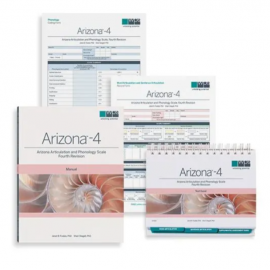
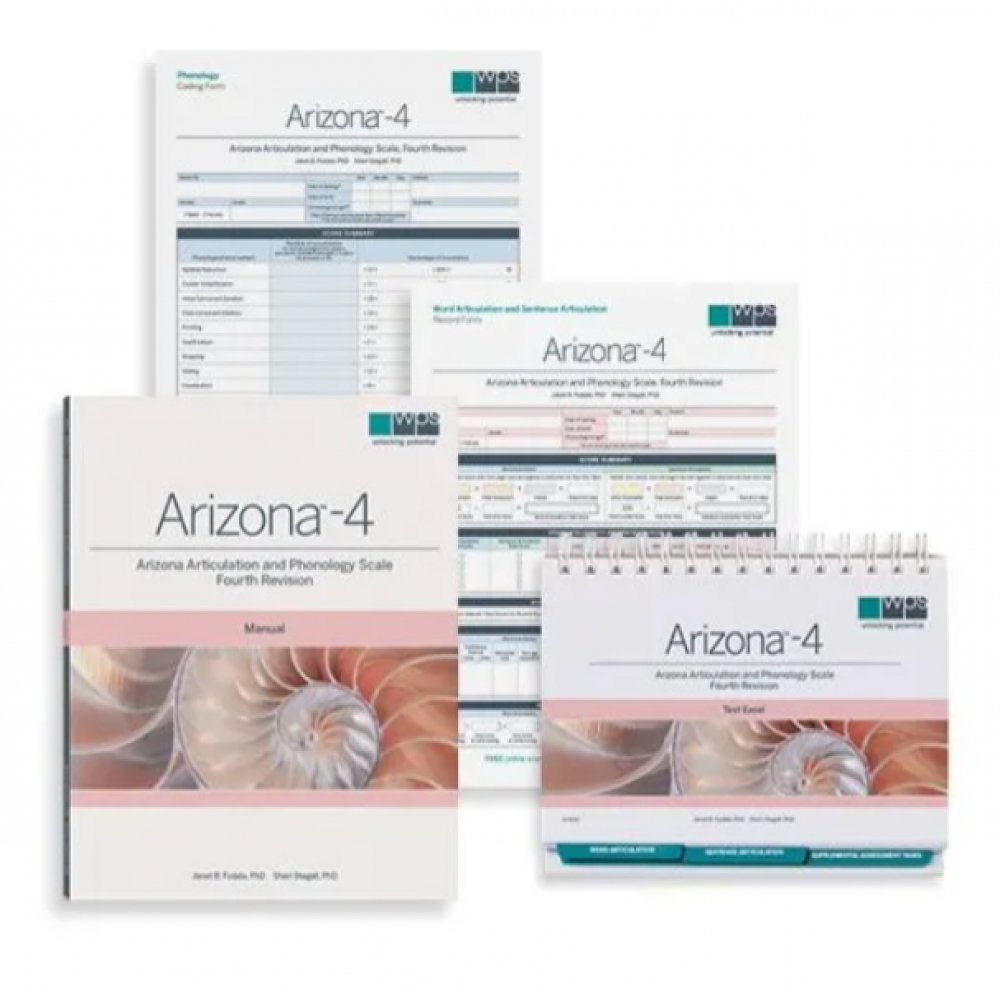
Provides a quick, reliable, and well-standardized measure of articulation and phonology to help clinicians identify individuals who need speech sound services
Standardized on a nationally representative sample of 3,192 children, adolescents, and young adults
The individual names, repeats, or reads stimulus content, and the examiner notes articulatory and phonological errors.
What’s New in the Arizona-4
- Three tests in one assessment: Word Articulation, Sentence Articulation, and Phonology
- All-new normative data
- Extension of the standardized age range to 21 years, 11 months, with guidance for describing and understanding the speech of adults of all ages
- Modified scoring system for more effective identification of individuals with speech sound disorders
- Five optional tasks that inform treatment plan development
- Scoring guidance for dialectal variations
- Full-color illustrations that are more engaging for young children
- Digital stimulus images
- FREE online scoring and report generation through the WPS® Online Evaluation System™
Overview
The Arizona-4 measures speech intelligibility, articulatory impairment, and phonological impairment in one easy-to-use assessment. It features enhancements that add to its effectiveness in identifying individuals who have speech sound disorders. New norms, refined measurement properties, and the addition of connected-speech and phonology tests help clinicians identify individuals who may benefit from speech sound services. Supplemental qualitative tasks facilitate deeper interpretation of the scores and help clinicians develop treatment plans targeted to the individual’s needs.
Applications and Uses
The Arizona-4 can be used by speech and language professionals in a variety of settings, including schools, clinics, hospitals, private practices, and intervention programs. Its applications include:
- Understanding and describing an individual’s level of articulatory ability and overall speech intelligibility in both single-word and connected speech
- Comparing single-word and connected-speech articulatory abilities
- Determining the extent to which phonological impairment may contribute to an individual’s articulatory deficits, and describing the specific types of phonological error patterns that are displayed
- Facilitating early identification of speech sound development concerns and determining whether an individual may benefit from treatment services
- Identifying and prioritizing speech targets for individualized intervention through analysis of the examinee’s specific articulatory/phonological deficits and relative strengths, including the production of consonants, consonant blends, vowels, and vocalic /r/
- Monitoring improvement in an individual’s speech sound production over time
- Evaluating the degree of consistency in an individual’s production of misarticulated sounds, the impact of speech sound deficits in continuous language and everyday speech, and the need for further language assessment or intervention
What It Measures
The Arizona-4 scores help clinicians to identify individuals who need speech sound services and to develop treatment plans for them. The primary score is the easy-to-understand Word or Sentence Articulation Total Score, which has a direct interpretation. Research using Total Scores links these scores to the rate of speech sound occurrence in American speech. This research expresses how often misarticulated sounds occur in everyday speech and their impact on speech intelligibility. The Word–Sentence Articulation Critical Difference Score provides further information about clinically meaningful differences between articulation in single-word versus connected-speech contexts.
Standard scores for Word Articulation, Sentence Articulation, and Phonology compare examinee performance with the performance of a typically developing peer group based on age (and gender, for younger ages). Severity ranges, confidence intervals, percentile ranks, and test-age equivalent scores further aid clinical interpretation. The Arizona-4 scores use easily understood descriptive language for parents and other nonprofessionals.
Expanded guidelines for interpretation cover topics of extreme scores, item-level analysis, percentage of occurrence of phonological error patterns, and use of the Arizona-4 to measure change over time. Additional qualitative information is available through various supplemental, nonstandardized tasks that help clinicians plan effective treatment for the individual.
The Arizona-4 offers the following scores:
- Total Scores and associated Speech Intelligibility Interpretation Values
- Standard Scores and associated severity ranges for the level of articulatory and phonological impairment
- Word–Sentence Articulation Critical Difference Score
- Percentage of Occurrence for phonological error patterns
- Percentage of Speech Improvement Score for retesting
How It Works
The Word Articulation and Sentence Articulation tests of the Arizona-4 are administered to the examinee and may be used singly or in combination, as needed. The Phonology test is coded by the clinician based on the examinee’s speech productions during Word Articulation.
Word Articulation may be administered using the Test Easel or the Digital Stimulus Images With Administration Guide. The clinician presents the stimulus content to the examinee, and the examinee names the depicted word or repeats it after the clinician; older examinees may read the words. The clinician records the examinee’s production of the target sounds on the Word and Sentence Articulation Record Form, and the clinician may choose to code these productions for 11 phonology error patterns on the Phonology Coding Form.
The target sounds in Word Articulation can be tested at the sentence level by administering Sentence Articulation using the Test Easel or the Digital Stimulus Images With Administration Guide. In Sentence Articulation, the single words from Word Articulation are embedded in brief, simple sentences that are spoken by the examinee (the examinee can read the sentences or repeat them after the clinician; sentences are written at a first-grade reading level). Direct comparisons can be drawn between the examinee’s productions of the Arizona-4 target sounds at the word and sentence levels.
After the clinician has administered the relevant articulation tests and coded for phonology as needed, the clinician can use the WPS Online Evaluation System for free online scoring and report generation. The clinician can also score manually.
FREE Online Scoring and Reporting
Upon purchase of an Arizona-4 Kit or Forms, you gain access to digital scoring through the WPS Online Evaluation System at no additional charge! This gives clinicians the option to score online and automatically generate the Score Report, including Item Discrepancy Analysis. Time saving and HIPAA compliant, WPS’s online testing platform securely and conveniently keeps a record of the clinician’s administrations and shares helpful information with parents, teachers, and others involved in treatment.
Components and Formats:
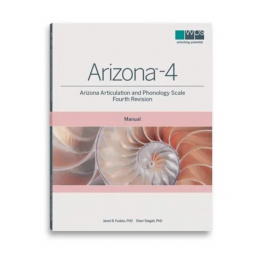
Manual
The Manual contains detailed information on the administration, scoring, interpretation, development, standardization, and psychometric properties of the Arizona-4.
Format: Online; Print
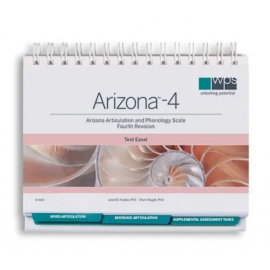
Test Easel
A self-standing stimulus book that includes all materials required to administer the Arizona-4, such as instructions, examples, pictures, test items, prompts, scoring criteria, skill descriptions for each item, and selected Supplemental Assessment Tasks. Sections are clearly tabbed for quick reference during administration.
Format: Print
Digital Stimulus Images with Administration Guide
The electronic version of the Test Easel includes digital stimulus images and a Digital Administration Guide for use online or offline. A Print Administration Guide is also included for added convenience.
Format: Online; Digital
Word Articulation and Sentence Articulation Record Form
An 8-page booklet used to administer and score Word Articulation and Sentence Articulation, as well as to support Supplemental Assessment Tasks. This form must be used during test administration. Scoring can be completed manually or automatically through the WPS Online Evaluation System.
Format: Print with Online Scoring
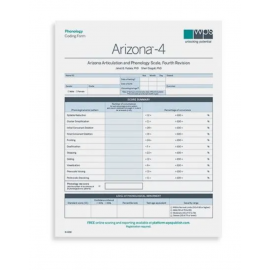
Phonology Coding Form
A 4-page booklet used to code and score phonology following the Word Articulation assessment. It is required for identifying phonological error patterns. Scoring may be completed manually or automatically through the WPS Online Evaluation System.
Format: Print with Online Scoring
Reliability and Validity
The Arizona-4 was standardized on a nationally representative sample of 3,192 children, adolescents, and young adults, aged 1 year, 6 months–21 years, 11 months. This sample was stratified to match U.S. Census data for gender, race/ethnicity, parents’ educational level, and geographic region. A clinical validation sample was also collected; the sample consisted of 50 individuals who had a speech sound disorder diagnosis (articulation and/or phonological disorder) and who were receiving treatment services.
The Arizona-4 has strong internal consistency, test–retest reliability, and interrater reliability, supporting the stability of Arizona-4 results within tests, over time, and across examiners.
Several studies provide valid evidence supporting the Arizona-4. The Arizona-4 scores show the expected progression of development for speech sound mastery and the expected age for specific target sounds and phonological error patterns, providing evidence of adequately captured speech sound development. Validity evidence also includes correlations with other established measures of articulation and phonology. A clinical study supports the ability of the Arizona-4 to distinguish those with clinically diagnosed speech sound disorders from those who do not. These results are indicative of sensitivity and specificity, as well as positive and negative predictive value, for the Arizona-4 tests.